Week 2, Wednesday 6 May, 2.30-3.30, OCHS Library
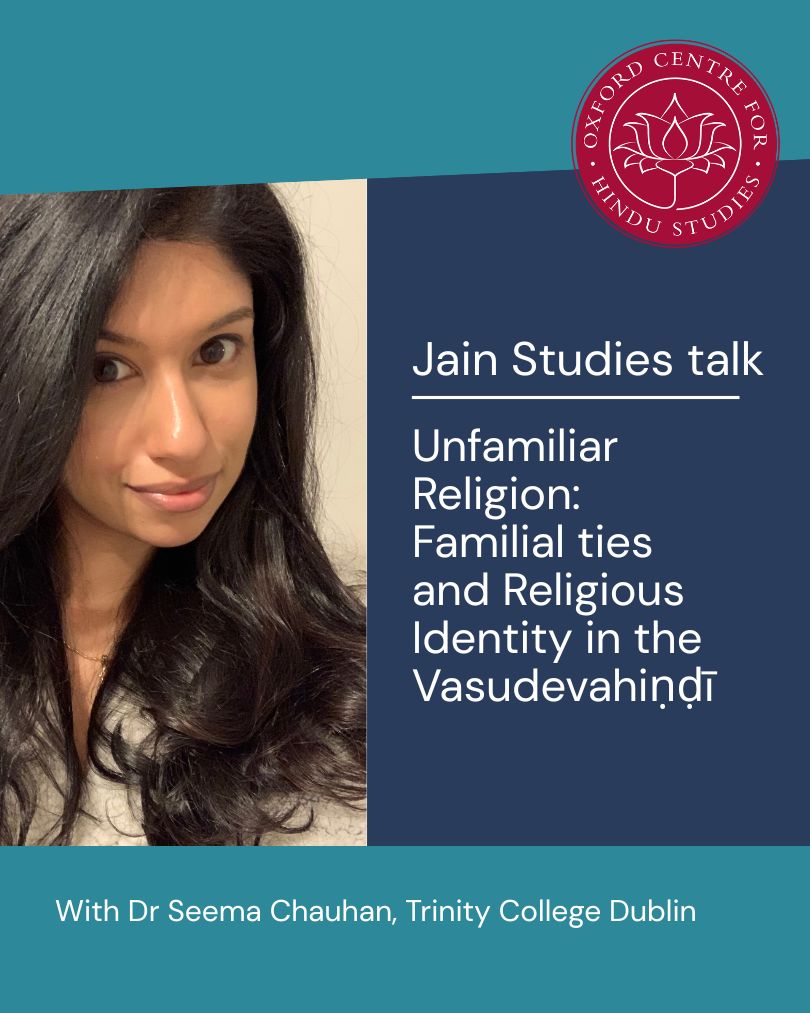
Dr Seema Chauhan
In the study of Jainism, it has become a truism to say that Jainas were interested in knowing the religious other. This is not a novel argument. What is less studied are the social identities that structure these encounters in stories, not to mention the literary methods used to write about the religious other. Put simply, when Jainas write stories about the religious other, who are the characters involved? And what motivates these characters to talk about non-Jaina religions?
In the Śvetāmbara suttas, it is usually the Jaina ascetic who encounters non-Jainas while on the road searching for alms. This makes for a narrative focused entirely on a conversation between Jaina ascetic and his other—a rather dry story devoid of any plotline because the ascetic has renounced all familial and sexual ties. But that is not the case for the Vasudevahiṇḍī, a fifth century CE Śvetāmbara narrative. There, it is sons who are looking for their long-lost fathers. And kings and nuns who try to justify incest and adultery. Such stories about day-to-day dramas inside the home become, I argue, the site for talking about non-Jaina religions. In this talk, I showcase such narratives, and answer how and why they use familial and sexual relationships to talk about unfamiliar religions.
Seema K. Chauhan is an Assistant Professor of Asian Religions at Trinity College Dublin. Prior to this appointment, she completed her doctorate at the University of Chicago Divinity School and held the Asoke Kumar Sarkar Early Career Fellowship in Classical Indology at Balliol College. She specialises in the history of early Jainism, Hinduism, and Sanskrit and Prakrit literature.