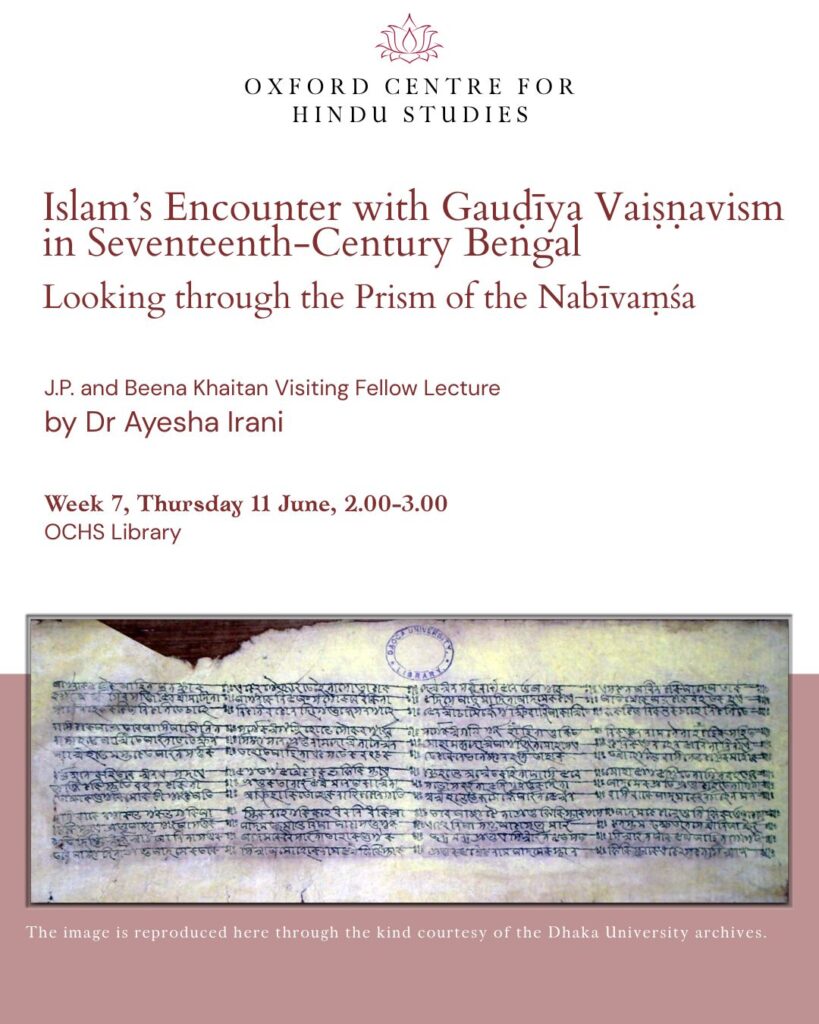
Saiyad Sultān’s seventeenth-century Nabīvaṃśa, “The Prophet’s Lineage”—a universal history of the Prophet Muhammad—was the first major text to present Islamic doctrine to Bengalis in their mother-tongue.
The greater part of Book One of the Nabīvaṃśa translates into Bengali the thirteenth-century Qiṣaṣ al-anbiyāʾ attributed to a certain Muḥammad ibn ʿAbd Allāh al-Kisāʾī; in Book Two, the author appends a full-blown biography of the Prophet Muḥammad, most likely a translation of an unknown source.
Sultān reconstitutes Islamic prophetology to include Hindu divinities and sacred texts, tacitly enlarging the Qurʾānic category of People of the Book to uniquely embrace the Hindus of Bengal. Specific Hindu deities, identifiable as Śiva and various avatāras of Viṣṇu, including Rāma, make their advent to eradicate evil from the earth. Their abysmal failure brings forth the creation of Ādam, and after him a line of prophets, including Śiś, Idris, Nūh, Ibrāhim, Musā, Dāud, Solemān, and Īsā, whose stories are told in some detail, culminating with the Prophet of Islam. Hari (Kr̥ṣṇa) is the only Hindu god who punctuates the line of traditional Islamic prophets after Ādam.
In this workshop, I shall share a draft-translation of the Hari cycle of the Nabīvaṃśa, which I am currently working on for the Murty Classical Library of India (Harvard University Press), and open up a discussion on the peculiarities of the Nabīvaṃśa’s Account of Hari in the context of the Vaiṣṇava corpus.
Ayesha A. Irani is Associate Professor of Asian Studies at the University of Massachusetts Boston. She is a scholar of Islam in South Asia and a specialist in the early modern literature of Bengal. Her first monograph, The Muhammad Avatāra: Salvation History, Translation, and the Making of Bengali Islam (Oxford University Press, New York, 2021), examines the role of translation in the Islamization of Bengal, through a close reading of the seventeenth-century Nabīvaṃśa (“The Prophet’s Lineage”), the first major work to translate Islamic doctrine for Bengalis into their mother-tongue. She is currently translating the Nabīvaṃśa for the Murty Classical Library of India, Harvard University Press, and is also working on two major research projects. The first involves writing a literary history of Sufism in early modern and colonial Bengal. The second explores Prabhāta Saṃgīta, a corpus of modern devotional songs composed by the charismatic spiritual master, Shri Prabhat Ranjan Sarkar (1921-1990), who is the founder of the global spiritual organization, Ananda Marga. In addition to these projects, she is co-editing with Lucian Wong a volume tentatively entitled, The Vaiṣṇava Sensorium. This volume brings together the cross-disciplinary work of a group of international scholars drawn from the fields of textual studies, philosophy, anthropology, history of religions, art history, and ethnomusicology to examine how the senses mediate the experience of the divine in Vaiṣṇava praxis in eastern India and beyond.