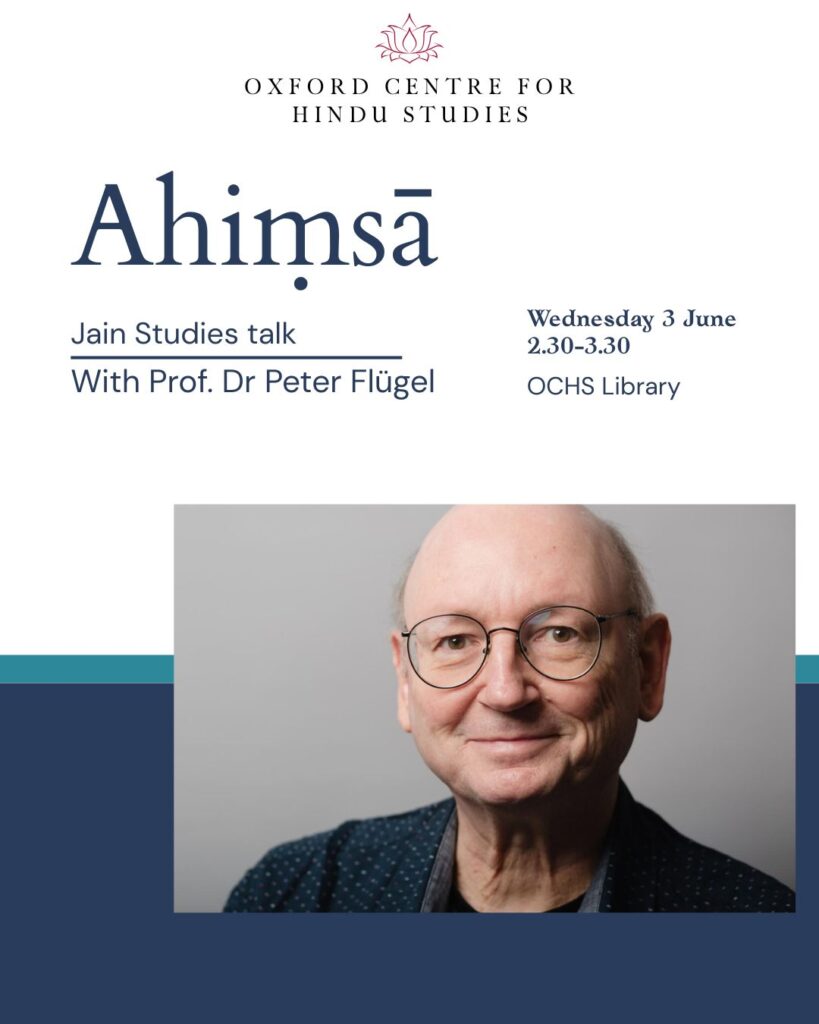
Wednesday 3 June, 2.30-3.30. OCHS Library. All are welcome!
“He who knows the violence done for the sake of special objects, knows what is free from violence; he who knows what is free from violence, knows the violence done for special objects” (Āyāraṅga 1.3.1.4). The apparent paradox, recognised in this and other canonical passages, that cognition of violence is a condition and hence integral part of a religious system aiming at the maximisation of non-violence, can be explained, with the help of the theory of autopoietic systems of N. Luhmann, as a consequence of the fact that all social systems constitute themselves through selective self-referential mechanisms, based on binary codes, programmes and routines, which constitute the elements of a system that function as its parts. The paper presents a theoretical interpretation of the Jaina tradition, arguing that, as a social system, the Jaina tradition reproduces itself with reference to a combination of an ontological code, jīva/ ajīva, and a moral code, ahiṃsā/hiṃsā, implemented through programmes, that is, criteria, for the allocation of objects and processes to one or to the other side of the constitutive distinctions directrices. Jaina philosophy itself highlights the significance of binary categorisations. Only with the development of the ahiṃsā-reductionism, predicated on the mushrooming of synonymous (a-) hiṃsā-words, described by K. Bruhn and C. Caillat, and the crystallisation of a central binary code in medieval times, the Jaina tradition could develop into a stable autopoietic social system, because all social systems are predicated on reductions of complexity. The paper argues that the self-differentiation of ahiṃsā through processes of semantic duplication and self-reference was the condition for the development of religious codes and programmes for their implementation, which still stabilise the Jaina system over time. As a social system, the Jaina religion is a relative late development. The paper presents an analysis of the semantics of (non)violence in the canonical Paṇhāvāgaraṇāiṃ.
Peter Flügel, Dr Phil Johannes Gutenberg-Universität Mainz, is Founding Chair of the Centre of Jaina Studies, and Professor of the Study of Religions and Philosophies at the Department of History, Religions and Philosophies at SOAS University of London.