Jain Seminar Series
Hilary Week 8, 11 March 2026, 2.30pm
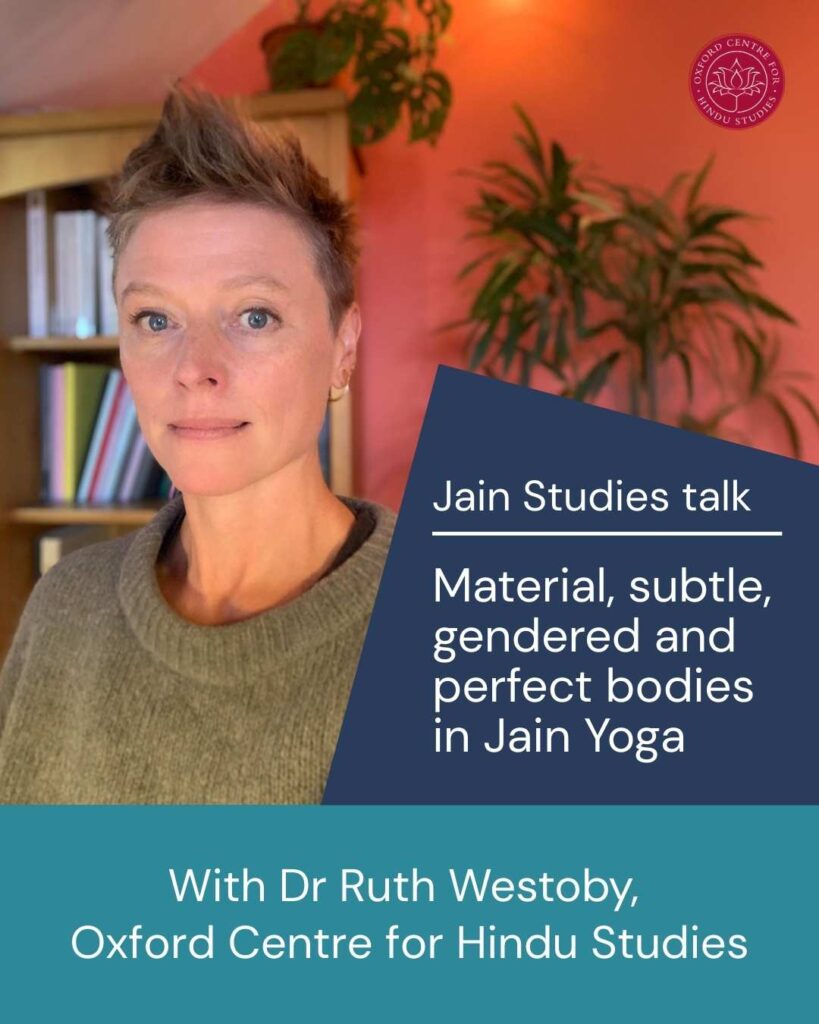
Dr Ruth Westoby
Abstract
Jain yoga sources in the early centuries of the second millennium adopt practices of physical yoga and adapt them to distinctly Jain theories of the body and soul (jīva), metaphysics, and stages of spiritual perfection. Sources such as Śubhacandra’s Jñānārṇava and Hemacandra’s Yogaśāstra teach physical practices, yet subordinate such physical practices to meditative techniques. There are many similarities with the Haṭha Yoga that emerges at a similar historical moment in sources from the Amṛtasiddhi to the Haṭhapradīpikā. This paper explores the presentation of the body in Jain sources in order to analyse both the rationale and efficacy of physical practices, and the role of materiality and gender in the physical—and liberated, body. Similarities and tensions are identified in the presentation of yogic bodies in the Haṭha corpus. I suggest that, for Jain sources, gender is a characteristic of the body in saṃsāra that is attenuated as the practitioner progresses. Though the perfected (siddha) body is in some ways beyond gender, it nevertheless also represents the paradigmatic male body.
Biography
Dr Ruth Westoby is a researcher in South Asian Religions and a yoga practitioner. She is a Postdoctoral Research Fellow in Jaina Studies at the Oxford Centre for Hindu Studies, focusing on technologies of the body in Jainism. As Affiliate Researcher at Inform, King’s College London and Associate Researcher at SOAS, University of London, Ruth researches bdoily practices and menstruation in yoga, tantra and neo-tantra. Her current book project is a study of the stopping of menstruation in South Asian religions. She teaches MA Yoga in the Modern World as Senior Teaching Fellow at SOAS. Her PhD from SOAS (2024), supervised by Prof. James Mallinson, explored The Body in Early Haṭha Yogaand was funded by CHASE-AHRC. She also collaborated with the SOAS Haṭha Yoga Project (2015-2020) interpreting early modern yoga postures, contributing to an emergent research methodology, ‘embodied philology’.