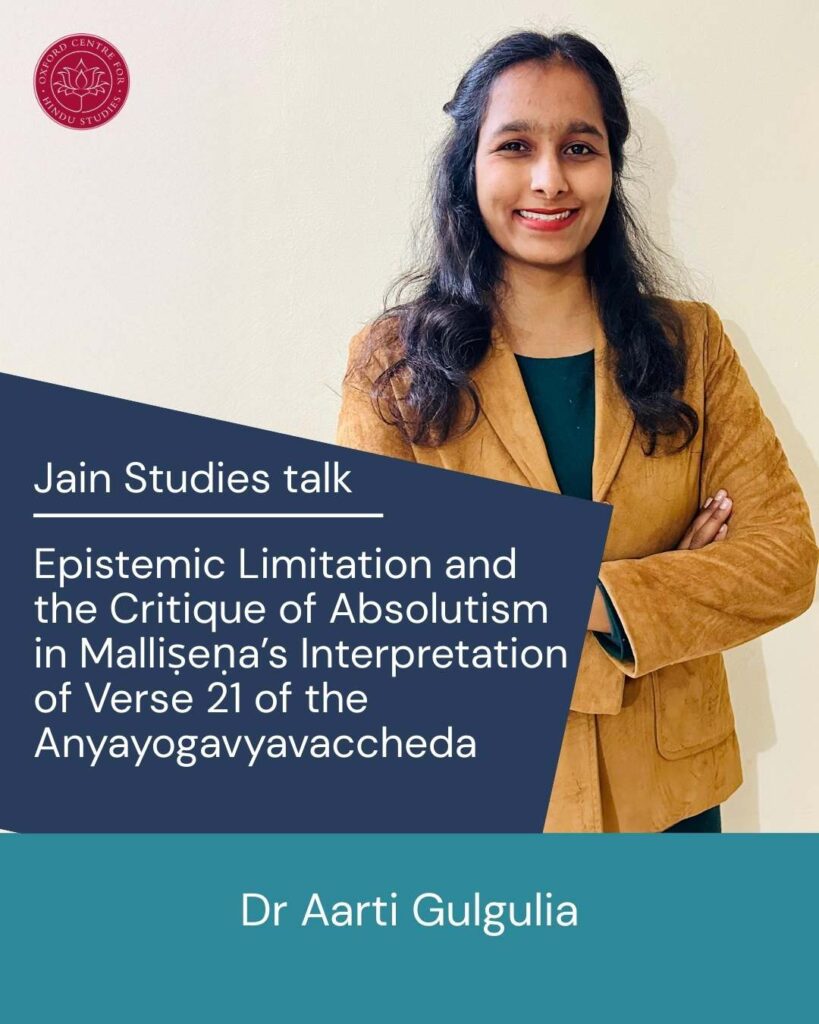
Talk 20 Feb 2.30 pm | “Epistemic Limitation and the Critique of Absolutism in Malliṣeṇa’s Interpretation of Verse 21 of the Anyayogavyavaccheda” by Dr Aarti Gulgulia

Abstract: In this paper, I show how verse 21 of Hemacandra’s Anyayogavyavaccheda, as interpreted in Malliṣeṇa’s Syādvādamañjarī, illuminates the epistemic limitations of absolutist judgments. Verse 21 asserts that existing entities are non-one-sided, as they simultaneously undergo origination (utpāda), destruction (vyaya), and persistence (dhrauvya). Malliṣeṇa explains this by distinguishing between substances (dravya) and modes (paryāya) as simultaneously fundamental parts of existing entities. From this, he criticises thinkers who, despite routinely engaging with non-one-sided entities, focus solely on one side of reality and fail to recognize its multiple aspects; they know reality “in an absolute way,” i.e., ruling out the existence of its other potential sides. According to Malliṣeṇa, such absolutist claims are due to intellects clouded by beginningless ignorance (mohaniya) and desire. Using textual analysis, I reconstruct Malliṣeṇa’s methodological approach, showing how one entity can be described in more than one way without contradiction. He does so by using examples coming from diverse sources, from earlier Śvetāmbara and Digambara sources to examples of everyday life found in Jain narrative literature. These examples range from the apparent colours of conch shells in jaundice, to mereological considerations around cut nails, and to the example of two brothers sharing the same mother. By situating syādvāda as a reasoning method to speak about multi-aspectual entities, this paper highlights three contributions of Malliṣeṇa’s thought: clarifies the limits of absolutist cognition, the importance of context-sensitive observation, and the constant use of examples provides a model for understanding non-one-sided reality that is more intuitive and that posits Malliṣeṇa’s thought within a specific lineage. This framework remains relevant for contemporary debates on epistemic pluralism.

Bio: Aarti Gulgulia completed her Ph.D. in Sanskrit at Amity University, Uttar Pradesh, India, where her doctoral research focused on Jain Yoga and Bauddha Yoga: A Comparative Analysis. She is currently pursuing an M.A. by Research in the Department of Theology and Religion at the University of Birmingham. Her research specializes in Jain epistemology, with particular attention to the doctrines of non-absolutism (Anekantavada), conditional predication (Syädvada), and sevenfold exposition (Saptabhargi). She has served as Visiting Faculty at Amity Law School, Junior Research Fellow awarded by the University Grants Commission, and Associate Editor of Dharma for Life Echoes (ISSN: 3049-2459). She has also worked as Editorial Assistant at the International School for Jain Studies and has qualified for the UGC-NET for Assistant Professor in both Prakrit and Buddhist, Jaina, Gandhian, and Peace Studies.

Publications:

  • The Many Faces of Renunciation: A Comparative Study of Asceticism Across
    World Religions
  • Contours of Early Indian Yoga: A Comparative Inquiry into Vedic and Jain
    Traditions