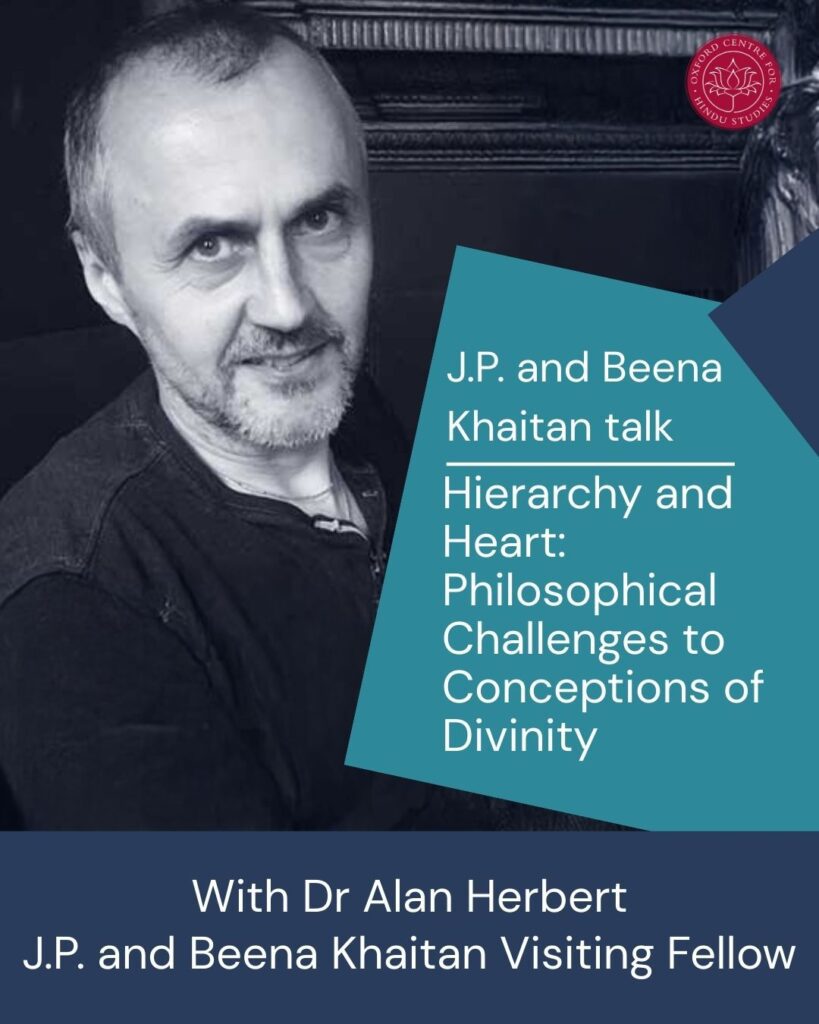
Lecture of the J.P. and Beena Khaitan Visiting Fellow
Week 4, Wednesday 11 February 2.30-3.30, OCHS Library
Dr Alan Herbert
I am interested in whether typical philosophical methods can adequately grasp diverse, and even contradictory, conceptions of divinity. As an illustrative example, I will look to the concept of Kṛṣṇa in Gauḍīya Vaiṣṇava theology. This tradition seeks to accommodate and balance a Vedāntic perspective in which Kṛṣṇa is positioned as the fullest expression of God, or Bhagavān, surpassing Brahman (by way of its interpretations of the Upaniṣads, Purāṇas, and Tantras), with its own intensely emotive bhakti (devotion), which regards Kṛṣṇa as incomplete without his intrinsic potency, or Śakti—specifically Rādhā, his closest confidante. This Gauḍīya approach raises questions about the problems that philosophy has in explaining hierarchical features of the divine alongside the deeply personal reality of God, the understanding of which, especially in this case of Rādhā-Kṛṣṇa, is often gained through a recommended participatory engagement in a religious process.
Alan Herbert’s specialities and interests lie in philosophy, religion, Indian thought and culture. He is also acquainted with sociology. He draws on a wide range of teaching experience in both tertiary and secondary/high school education in the USA, UK, and Asia, all of which informs his research. Currently, he is a research fellow at the Oxford Centre for Hindu Studies. There he directs research projects, develops and runs online courses, teaches, tutors, mentors, publishes, and organises conferences. Recently he has been working on projects and papers exploring issues in the philosophy of religion, philosophy of mind, personal identity, imagination studies, Indian theology, and societal problems among contemporary Hinduism and Hindus.