Category: Academic

20 May: Postgraduate Seminar in Hindu Studies with presentations from Gonzalo Fernandez, Utsa Bose, and Sharvi Maheshwari

20 May: Postgraduate Seminar in Hindu Studies with presentations from Gonzalo Fernandez, Utsa Bose, and Sharvi Maheshwari

Convened by Dr Bjarne Wernicke-Olesen

Week 4, Tuesday 20 May, 2.00-3.45, OCHS Library

This series of termly seminars focuses on current DPhil research in Indic religions with a Study of Religion oriented approach: in each seminar, 2-3 DPhil candidates will present on a topic they are investigating for 20 min and then open it for discussion on key questions. These informal seminars offer an excellent way to discover and learn about current research in the field of Hindu Studies as well as an opportunity for candidates to present and receive valuable feedback on work in progress. All researchers, graduates and finalists in all areas are welcome to join. Tea and biscuits will be served.

An Examination of the Soteriological Role of Yoginīs in Śākta Tantric Śaivism

Gonzalo Fernandez

My thesis investigates the role that yoginīs (semi-divine spirits) have to play in granting liberation to their devotees, a topic that has not been addressed in any detail by scholars. The method is text-historical and philological and involves an analysis of tantras and exegetical materials in order to determine the different ways in which yoginīs liberate. The principal focus of the thesis will be on the Netratantra, an early ninth century work that serves as a prototypical example of yoginīs performing a salvific role and reveals a number of different methods employed to achieve this aim.

The key goals of liberation and the grant of supernatural powers evidenced in the tantras allowed Śākta tantric Śaivism to absorb other traditions and to broaden its appeal. This includes low caste heterodox practices involving possession and the worship of yoginīs. It is argued that this incorporation of popular extraneous religious practices was made possible by interpreting yoginīs as salvific agents of Śiva or as aspects of Śiva’s active power (Śakti). It is further argued that the different methods employed by yoginīs to liberate their devotees came to be understood through the lens of a distinctive Śākta soteriology, that was increasingly congruent with the core teachings of Śākta tantric Śaivism.

Translation, Meaning and Metaphor: Two Śākta Readings of a Pandemic in Calcutta

Utsa Bose

The so-called third bubonic plague pandemic—believed to have originated in southern China— reached British Hong Kong in 1894, from where it travelled to Bombay in 1896. From Bombay, it soon spread to other cities in British India. In April of 1898, Calcutta, the capital of British India, was declared infected with plague. While the pandemic saw a great scramble for diagnosis, changes in medical management and general administration, it also brought to the fore fundamental questions regarding causation, life, and suffering.

While the plague pandemic has been looked primarily through the lens of medical and scientific history, the philosophical and theological challenges it engendered have received comparatively lesser attention. Calcutta, while being the capital of British India, was also undergoing a strong Śākta revivalism in this period, and these religious undercurrents inflected narratives about the plague. My presentation looks at two such Śākta readings of the plague, analysing the similarities, divergences and methods through which the pandemic was understood, explained and translated.

The Transfer of Energy Among Goddesses: Codification and Transformation in Bhaktapur’s Śākta Traditions

Sharvi Maheshwari

This presentation examines how goddess figures in Bhaktapur, Nepal, engage in dynamic processes of transformation and energy transfer within the city’s rich Śākta traditions. Rooted in the cultural and religious history of the Newar community, these practices reflect a fusion of local tantric rituals with broader pan-Indic and Brahmanical influences. To analyze this ritual complexity, I introduce a conceptual model—referred to as The Codes—which helps deconstruct and reassemble tantric practices by identifying the logics behind ritual absorption, symbolic exchange, and the layering of traditions. The model reveals how goddess systems in Bhaktapur evolve through a process of ritual codification, absorbing elements from other traditions to gain legitimacy and broader appeal.

The presentation draws on ethnographic fieldwork and performance analysis of the Navadurgā festival cycle to illustrate these patterns. Through three case studies, I explore how energy is transferred among goddesses and between divine and human actors, highlighting the polyvalent nature of these figures. Ultimately, this research contributes to understanding how peripheral Śākta traditions both preserve and adapt their identities in response to historical and cultural shifts, offering a new lens on ritual transformation in South Asian religious practice.

14 May: Documentary Film Screening of “Goddess Durga Unveiled: The Timeless Power of Emotion” by Dr Ranjamrittika Bhowmik

14 May: Documentary Film Screening of “Goddess Durga Unveiled: The Timeless Power of Emotion” by Dr Ranjamrittika Bhowmik

Dr Ranjamrittika Bhowmik

Week 3, Wednesday 14 May, 2.30-4.00, OCHS Library

My documentary film, Goddess Durga Unveiled: The Timeless Power of Emotion, was produced by the Berlin University Alliance and is an output for my postdoctoral research for our project, Museums and Society:Mapping the Social at the department of European Ethnology, Humboldt University of Berlin. It is on the journey of Goddess Durga as a museum object in Europe and as a living Goddess in India, affective associations, Durga puja traditions in India, postcolonial museology, while telling her story through living traditions. It has been screened at the Babylon theatre in Berlin and will be screened at King’s College, London on 13 May.

You can read a little more about it and watch the trailer here:

https://museumsandsociety.net/en/news/publications/goddess-durga-unveiled-the-timeless-power-of-emotion-2

Ranjamrittika Bhowmik is a postdoctoral researcher at the Department of European Ethnology, Humboldt University of Berlin. She received her DPhil in South Asian Studies from the University of Oxford in 2023. Her doctoral research explores esoteric yoga traditions in northeastern India through shared Buddhist and Hindu lineages, focusing on the Rājbaṃśī community and their oral literature in the Rājbaṃśī lect. Her work engages with mysticism, tantric traditions, metaphor, and the politics of alternative social imaginaries, examining concepts of the subtle body and the literary and performative expressions of dissent. Trained in Cultural Anthropology and Comparative Literature, her postdoctoral project—at Humboldt University and the Museum of Asian Art, Berlin—investigates the history of emotions, forgotten object histories, memory, decolonization, AI ethics, and intersectionality. She has held fellowships from Jadavpur University, the Government of India, the European Union & the Universities of Milan, University of Lausanne, University of Oxford, and the OCHS.  Ranjamrittika is committed to conserving and promoting intangible cultural heritage, indigenous knowledge systems, and the oral traditions of marginalized communities.

View the trailer here.

8 May: Talk on “Cow, Union Buster! Identitarianism and Organizing in Bombay’s Mills, 1850s − 1990s” by Dr Parashar Kulkarni

8 May: Talk on “Cow, Union Buster! Identitarianism and Organizing in Bombay’s Mills, 1850s − 1990s” by Dr Parashar Kulkarni

8 May: Talk on “Cow, Union Buster! Identitarianism and Organizing in Bombay’s Mills, 1850s − 1990s” by Dr Parashar Kulkarni

Virtual Classroom

Dr Parashar Kulkarni 

Week 2, Thursday 8 May, 2.00-3.00, OCHS Library

This book-length project examines the role of cow protection in resisting labour struggles in Bombay’s cotton mills from the birth of industrialization in the 1850s to its eventual decline in the 1990s. Relying on public discourse in newspapers, government reports, and union documents, it shows that cows, sacred to Hindus, became a symbol of identity and a basis for elective affinity between mill owners, political/religious leaders, and a pro-capital city government. Mill owners funded cow protection societies, political/religious leaders supported cow protection and mediated directly with mill owners, and the state offered legitimacy, further resisting the negotiating power and innovations of labour unions to demand better living and working conditions. By implicating cow protection (identitarianism/ communalism more broadly) in the political economy of industrial capitalism, this essay shifts attention from its primarily nationalist, majoritarian, and often agrarian discourse.

Parashar Kulkarni specializes in the political economy of religion in colonial and contemporary South Asia and the British Empire. He is currently visiting the Institute of Advanced Legal Studies at UCL. Previously, he has taught at Yale-NUS College and has a PhD from New York University. (https://sites.google.com/view/parasharkulkarni/)

Oxford Student Theology Society Talks for Trinity Term 2025

Oxford Student Theology Society Talks for Trinity Term 2025

Please join the Oxford Student Theology Society for the first of three talks in Trinity Term 2025!

Wednesday 14th May (3rd week), 5pm
What is theology? Christian Theology and the Community of the Church
by Prof. Johannes Zachhuber, Trinity College Oxford
Location: Christ Church, Lecture Room 1

Wednesday 21 May, 5pm
Interpretative Community and Philosophical Hermeneutics
by Prof. Hindy Najman
Location: MacGregor Room, Oriel College
Wednesday 11 June, 5pm
The Comparative Imperative: Why We Need Comparative Religion
by Prof. Gavin Flood
Location: MacGregor Room, Oriel College

The talks will last about 30 minutes to be followed by Q&A and refreshments.

When the ‘esoteric’ strikes back: Revising the field of tantric studies

When the ‘esoteric’ strikes back: Revising the field of tantric studies

The Intersection of Hinduism and Contemporary Society project

Presenting our next online guest lecture in the Invited Speaker Series

When the ‘esoteric’ strikes back: Revising the field of tantric studies

Friday, 29th November 2024, 6pm UTC/GMT
By Dr. Monika Hirmer (Friedrich-Alexander Universität, Erlangen–Nürnberg, Germany)

Registration

Please register at: https://www.eventbrite.com/e/ochs-ihcs-invited-lecture-series-monika-hirmer-tickets-1086879308269?aff=oddtdtcreator

We will send you a zoom link two days before the event.

Abstract

South Asian tantric traditions have fascinated Western scholars ever since the first colonial encounters, when the term ‘Tantrism’ was coined to indicate a set of practices deemed irrational and morally deprived, as opposed to the supposedly rational and morally superior religious practices of the West. This Orientalist view has nowadays been superseded by more nuanced perspectives, which acknowledge the complexity of South Asian tantric traditions, and emphasise, as some of their primary features, the presence of a guru, the importance of rituals and yantras, and pervasive correspondences between the micro- and macrocosmic realms. Acknowledging the inherent fluidity of tantric practices has paved the way for the most recent scholarly developments in the field, which explore the thus-far understudied interactions between pan-Indian and folk traditions, and mainstream and unconventional ritual practices in South Asia.

While tantric scholarship has advanced significantly, the fact that its focus is mostly limited to South Asia excludes some of the most prominent cross-cultural interactions, namely those engendered by the diffusion of tantric practices in the West. In fact, tantra in the West remains largely ignored by eminent scholars in the field of tantric studies, and is instead explored under different rubrics, such as ‘new religious movements’, ‘esoteric traditions’ and ‘Neotantra’, giving rise to a schism between tantric traditions in South Asia and tantric traditions in the West. Without denying the distinctiveness of tantra in the West and its problematic appropriation strategies, I argue that, as long as the field of tantric studies fails to incorporate Western tantric traditions, it recreates the same colonial dichotomies and violent hierarchies that were advanced by Orientalist scholars—only that, this time around, the ‘Other’ is the West, in opposition to a more authentic and, therefore, superior South Asia.

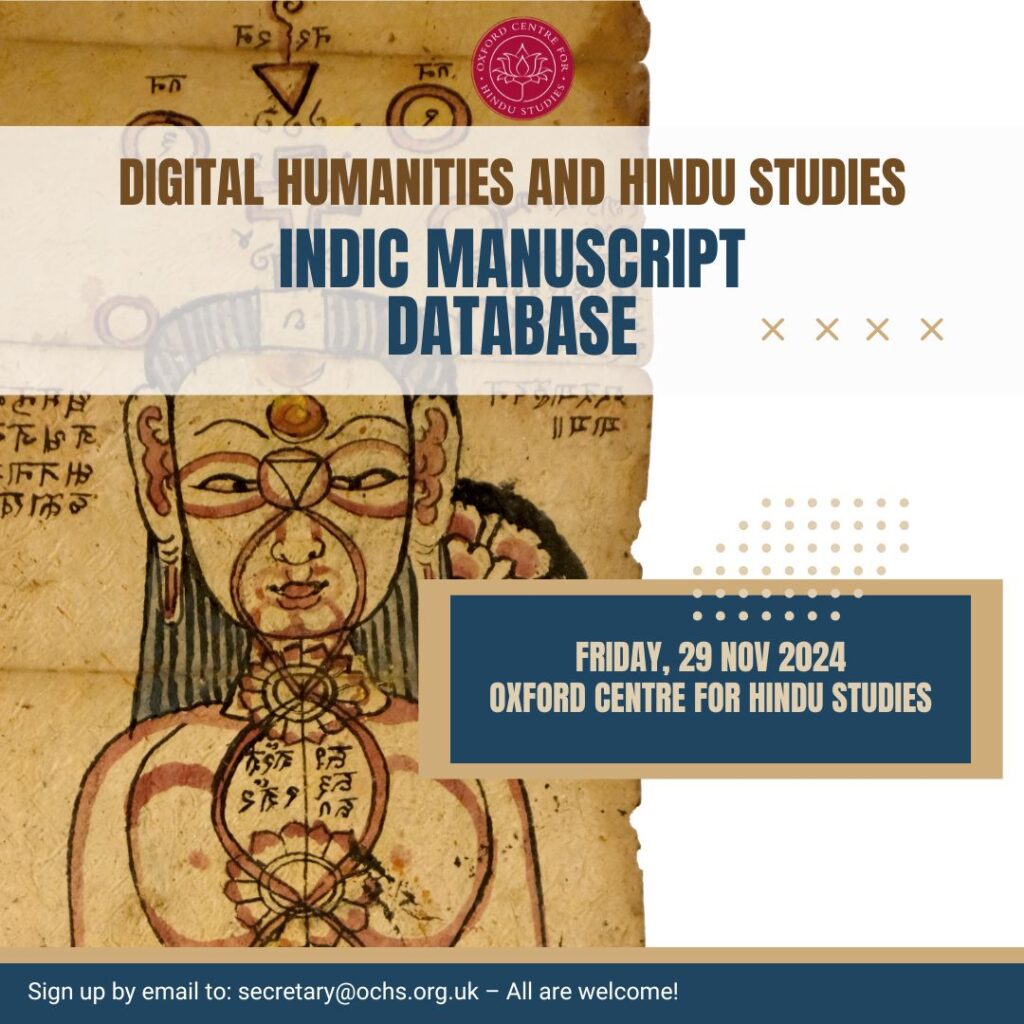
Indic Manuscript Database Launch

Indic Manuscript Database Launch

OCHS INDIC MANUSCRIPT DATABASE LAUNCH

Venue: Oxford Centre for Hindu Studies Online,
13–15 Magdalen Street, OX1 3AE, Oxford.
– All are welcome!

10.50-11.00 Tea/coffee
11.00-11.05 Welcome: Professor Gavin Flood, Dean of Hindu Studies

11.05-11.20 Introduction: Dr Bjarne Wernicke-Olesen
11.20-12.00 OCHS Indic Manuscript Database Launch: Dr Ulrik Lyngs

12.00-12.15 Break

12.15-12.30 Gauḍīya Patrikā: A Digital Archive of Bengali Vaiṣṇava Periodicals: Dr Lucian Wong
12.30-13.00 Creating AI models for Handwriting and Text Recognition in South Asian Manuscripts (Digital Scholarship Development Grant): Tom Derrick

13.00-14.00 Lunch

14.00-15.00 Technical deep dive for developers: Understanding & extending our Database & Web Apps: Dr Ulrik Lyngs

Sign up by email to secretary@ochs.org.uk
You can also join the event via Zoom. 

Join our team! Postdoc in Jain Studies

Join our team! Postdoc in Jain Studies

Bhagawan Sumatinath Jain Postdoctoral Study

The Oxford Centre for Hindu Studies (OCHS) is pleased to announce that we are accepting applications for the Bhagawan Sumatinath Jain Postdoctoral Study fellowship. Deadline for applications is 18 November 2024.

The role is 0.75 FTE on a fixed-term contract lasting three years with a part-time annual salary of £28,000.

As part of your application, please provide a copy of your current CV, a covering letter (max 1 page), an outline describing your proposed research plan (max 3 pages), and 2 references with email contact information. The ideal candidate will hold a PhD (or be close to completing a PhD) in a relevant field.

Responsibilities of the role:
– Carry out a research project in the field of Jain Studies
– Organise a research symposium (in-person or online)
– Engage and network with leading Jain Studies scholars based in the UK and other European countries
– Publish (or at least submit for publication) two journal articles
– Work on making the PhD thesis ready for publication
– Develop an online course for the OCHS Continuing Education Department

Please note that this is an in-person role and the candidate is expected to be in Oxford during term time.

 
Apply for this position by email to Shawna at secretary@ochs.org.uk
 
About the OCHS 

The Oxford Centre for Hindu Studies (OCHS) is the global leader in Hindu Studies. We are committed to the academic study of Hindu cultures and traditions in all periods and parts of the world. As an academic institution, the OCHS is not affiliated with any religious or political group and welcomes staff, students, and visitors of all backgrounds. Our unique scholarly environment opens the way to ground-breaking research in interdisciplinary fields of study.

Teaching Hindu Studies and Indian Languages are core activities at the Centre. We collaborate closely with the University of Oxford; our Fellows tutor, teach and supervise students of the University. Our mission is to contribute to a more holistic global discourse and educate students to become first-class scholars and future leaders in fields including education, philosophy, religion, ecology, literature, and politics.

Building upon the academic status of the Centre we have been able to provide Continuing Education consisting of online courses and weekend schools. We currently have 40 courses available and more than 11,000 enrolments, making Hindu Studies accessible to a global audience. We enjoy meaningful engagement with many levels of society, not least with local Hindu communities, which sets us apart and models a holistic approach. It is within this comprehensive, cultural awareness that we are able to provide chaplaincy services and support Hindu art, literature, and culture.

Bursaries and Scholarships 2024

Bursaries and Scholarships 2024

£15,450 to award to students this year!

We are now accepting applications for our bursaries and scholarships and all our Oxford University students and Visiting students are invited to apply. The deadline is 22 April 2024, before 12 pm.

You should apply by sending a short letter of application to Hari at secretary@ochs.org.uk explaining what you are studying, the reasons for your application, how much you are applying for and include a budget to show us how you plan to use the bursary or scholarship. 

List of bursaries and scholarships: 
Swami Haridas Giri Scholarship: £6,000
The Spalding Memorial Educational Trust: £2,700
The Parvathi Foundation: £1,500
Jiva Goswami Scholarship: £1,050
Tristan Elby: £1,000
Amit Mishra Scholarship: £700
Aku’s Bursary: £500
Professor Charu Chandra Dasgupta Memorial Bursary: £500
Narasimhacharya Bursary: £500
Hansraj and Kanchanben Popat Bursary: £500
The Tagore Centre UK Bursary: £150
Ramalah Alagappan Bursary: £100
Gopal and Elizabeth Krishna Bursary: £100
Wernicke Olesen’s Bursary for Pali and Sanskrit Studies: £100
Professor Makhanlal Roy Chaudhury Book Prize: £50

A warm thank you to all our generous donors who are supporting the next generations of Hindu Studies scholars. 

The Professor Charu Chandra Dasgupta Memorial Bursary

The Professor Charu Chandra Dasgupta Memorial Bursary

New Bursary Endowment:
The Professor Charu Chandra Dasgupta Memorial Bursary

Thanks to a generous endowment from the Nahar Foundation & the Dasgupta Family we are now able to offer a new bursary at the OCHS to support students, faculty, and other individuals involved in the study of ancient Indian languages and history.

The bursary is established in memory of Professor Charu Chandra Dasgupta who was born on September 6, 1908, in the Dinajpur district of present-day Bangladesh, into a respected Vaidya family. His father, Hem Chandra Dasgupta was the first Indian full-time professor and Head of the Geology Department at Presidency College. A renowned and visionary educator, Hem Chandra made pioneering contributions to mass education in Bengal. Professor Charu Chandra Dasgupta followed in the footsteps of his father and, from a very early age, distinguished himself in the study of history. He was awarded the prestigious Premchand Roychand Scholarship and eventually the Mowat gold medal. He earned two doctoral degrees: the first from Calcutta University in 1944 and the second from Cambridge University in 1946. He held various professorships including the Head of Department of Ancient Indian and World History at Sanskrit College in Calcutta and later served as the Principal of Darjeeling Government College in West Bengal.

Professor Dasgupta’s scholarship led to significant advances in the field of ancient Indian fine arts and scripts. He authored four books and more than a hundred scholarly articles in various academic journals. Among these is his seminal work, “The Development of Kharosthi Script,” which is still widely regarded as an indispensable source for the study of the Kharosthi Script. As a prolific scholar, Professor Dasgupta’s research interests were broad and spanned various other disciplines including fine arts, sculpture, architecture, numismatics, history, anthropology and conservation of archives. He was an active member of various scholarly and academic societies including the Asiatic Society and Bangiya Sahitya Parisad. At the time of his death on 23rd June 1962, Professor Dasgupta was less than 54 years of age. But despite his relatively short lifetime, his accomplishments as a scholar remain exemplary.


Middle Bengali Imaginary seminar

Middle Bengali Imaginary seminar

Inaugural workshop for the Body and Embodiment in the Middle Bengali Imaginary project

Body and Embodiment in the Middle Bengali Imaginary” is an exciting new research project in the field of Bengali religion and literature co-directed by Dr Robert Czyżykowski (Jagiellonian University) and Dr Lucian Wong (OCHS). This 2-year project, which was recently awarded a € 50,000 grant by Jagiellonian University’s Strategic Program Excellence Initiative, aims to bring a varied team of specialists together to examine how ideas of the body and embodiment take shape in premodern Bengal’s rich and multi-religious corpus of vernacular literature.

The project held its inaugural workshop, funded by the OCHS, on 16-18 January 2023 at the Institute of Religious Studies at Jagiellonian University. Participants presented preliminary papers examining the theme of the body and embodiment in such diverse religious currents as Sufism, Gauḍīya Vaiṣṇavism, Śāktism, regional epic literature, hāṭha-yoga, and tantra.

Over the next 2 years, this working group will continue to develop these papers through monthly virtual meetings, an EASR conference panel, and a second workshop in Krakow in spring 2024. The project will culminate in an Open Access volume of critical essays and translations, which will make some of this fascinating premodern Bengali body-discourse available in the English language for the first time.  

Workshop participants (in the order of presentation):

  • Joel Bordeaux (Leiden University)
  • Keith Cantu (Friedrich-Alexander-Universität Erlangen-Nürnberg)
  • Rebecca Manring (Indiana University Bloomington)
  • Mriganka Mukhopadhyay (University of Amsterdam)
  • Naba Gopal Roy (Sidho-Kanho-Birsha University)
  • Ayesha Irani (University of Massachusetts)
  • Lucian Wong (Oxford Center for Hindu Studies)
  • Robert Czyżykowski (Jagiellonian University)
  • Ishan Chakrabarti (University of Chicago)

For more info about the project, click here